For facilities that handle food or pharmaceutical products, FDA-compliant commercial doors need to support the sanitary conditions required throughout the building. That means choosing doors that are easy to clean, suited to the environment, and capable of maintaining separation between areas where contamination or temperature changes could affect the product.
DuraServ provides regulated facilities with commercial door installation, repair, and maintenance built around the realities of daily operation and compliance. In this guide to FDA-compliant commercial doors, we’ll walk you through the essential door features, materials, and applications facility teams should consider when evaluating their options.
What Makes Commercial Doors FDA Compliant?
FDA regulations do not generally certify individual commercial door models as compliant. Instead, they establish requirements for the design, construction, sanitation, and operation of regulated facilities.
The proper door depends on the room, the product being handled, cleaning procedures, traffic volume, and whether temperature or air pressure must be controlled.
For example, in food processing, FDA guidance emphasizes plant designs that reduce contamination risks and make sanitation easier. This can include separating raw and ready-to-eat production areas and controlling the movement of people, equipment, and air between spaces.
Sanitary Materials & Non-Porous Finishes
Doors used in washdown, processing, or controlled areas should have surfaces that can be cleaned thoroughly without deteriorating under normal sanitation procedures.
- Stainless steel is common in these environments because it provides a smooth, durable surface and resists corrosion. Depending on the application, 304 or 316 stainless steel may be specified based on the chemicals, moisture, or cleaning agents present.
- Fiberglass-reinforced plastic and other durable composite materials can also work well where moisture resistance and easy cleaning are priorities.
However, door material is only one part of the equation. The entire door assembly should support the facility’s sanitation program, including faces, frames, seals, and hardware that do not create unnecessary places for food residue, moisture, or debris to collect.
Washdown Ratings & Seamless Construction
Food processing doors may be exposed to water, cleaning chemicals, and repeated sanitation cycles, so the whole system needs to hold up under those conditions.
Pay close attention to:
- Joints and seams where residue can collect
- Hardware, vision panels, and seals
- Controls and operators exposed to washdown
- Frame and bottom seals that help maintain separation
Flush surfaces and sealed components make cleaning easier and reduce areas where buildup can develop.
For high-pressure washdown areas, make sure the door, controls, and surrounding components are all rated for that environment. Exterior openings should also seal well enough to help limit pest entry, while interior doors may need to separate production zones.
Essential Door Types for Food Processing and Pharmaceutical Facilities
Door requirements can change significantly from one part of a regulated facility to another. A production opening may need fast cycling and easy cleaning, while a cooler, cleanroom, or pharmaceutical space may place more emphasis on temperature control or separation.
High-Speed Hygienic Roll-Up Doors
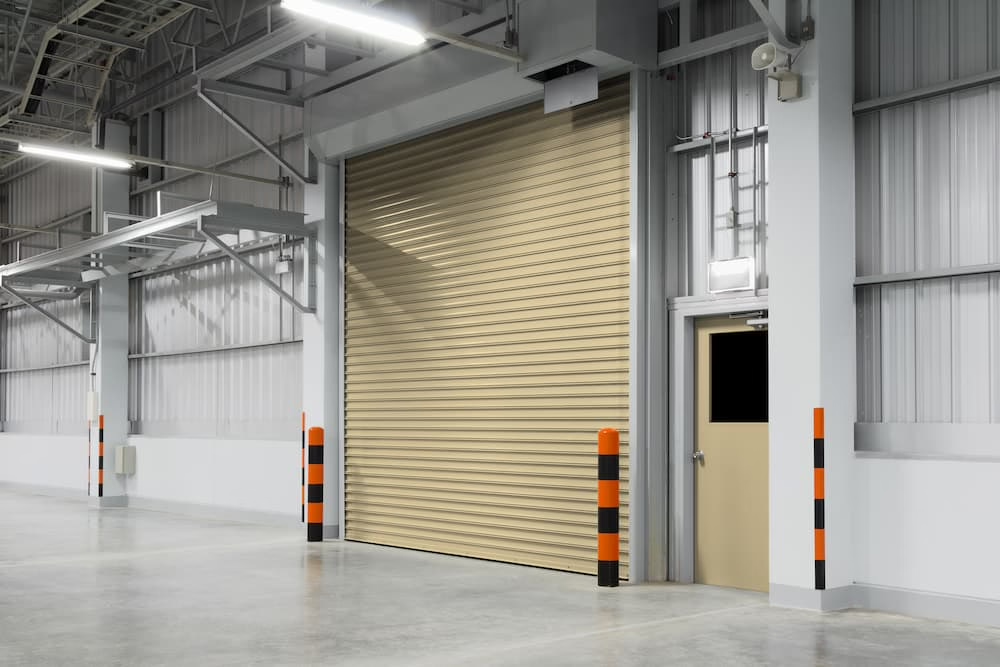
High-speed doors work well in areas where employees, carts, forklifts, or materials move through an opening throughout the day. Fast cycling helps reduce the amount of time the opening stays exposed, which can support temperature control and smoother traffic flow.
For sanitary applications, look closely at:
- Curtain or panel material
- Side guides and seals
- Controls and operator components
- Access for cleaning and sanitation
The door should be able to handle the facility’s cleaning routine while continuing to cycle reliably. DuraServ installs high-speed doors for food processing facilities, cleanrooms, and other industrial environments where hygiene and environmental control are important.
Stainless Steel & FRP Swing Doors
Not every opening needs an automated high-speed system. Swing doors remain useful between processing rooms, corridors, storage spaces, and other areas where traffic is lighter or where a simple physical separation is sufficient.
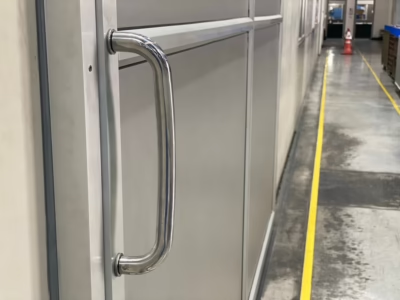
Stainless steel doors are often selected where durability and corrosion resistance are important. FRP doors can provide another practical option in wet or corrosive environments.
Steel door impact resistance matters as well. Carts, bins, pallet traffic, and equipment can quickly damage a door that was designed for ordinary commercial use rather than a production environment.
In pharmaceutical facilities, room separation may play an even larger role. FDA CGMP requirements call for facility layouts that reduce contamination and mix-ups, with specific controls required for certain manufacturing operations.
Key Benefits of Upgrading Your Facility’s Compliance Doors
Old or poorly suited doors can create problems that go beyond the opening itself. Damaged surfaces may be harder to clean, worn seals can affect temperature or pressure control, and repeated exposure to moisture or chemicals can lead to premature wear.
Upgrading to FDA-compliant doors that fit the application can help facilities:
- Maintain cleaner separation between production and storage areas
- Make routine sanitation easier to manage
- Limit unnecessary air exchange in temperature-controlled spaces
- Reduce failures caused by corrosion, moisture, or heavy cycling
Those improvements can be an advantage during inspections and customer audits, when equipment condition becomes part of the larger sanitation and contamination-control picture. FDA CGMP requirements address facility construction, maintenance, sanitary operations, and controls used to protect regulated products.
There are operational benefits as well. Fast-acting doors with effective seals spend less time open, helping maintain interior conditions and reduce strain on heating or cooling systems. DuraServ provides high-speed and cold-storage door systems for facilities where environmental control and frequent cycling are part of daily operation.
Partner With DuraServ for Expert FDA-Compliant Commercial Door Solutions
In regulated facilities, effective door solutions should support daily operations, not impede them. If a door is difficult to clean, does not seal properly, or cannot handle the pace of daily use, it can become an ongoing problem for both workflow and compliance.
DuraServ works with food processing plants, cold storage facilities, pharmaceutical environments, and other commercial operations to install, repair, and maintain doors built for demanding conditions. Our team can look at the opening, talk through how the space is used, and help you choose equipment that fits the application.
If your facility is replacing an existing door or planning a new controlled opening, contact your local DuraServ team to discuss the project and available options today.
Photographer: DifferR / Shutterstock